
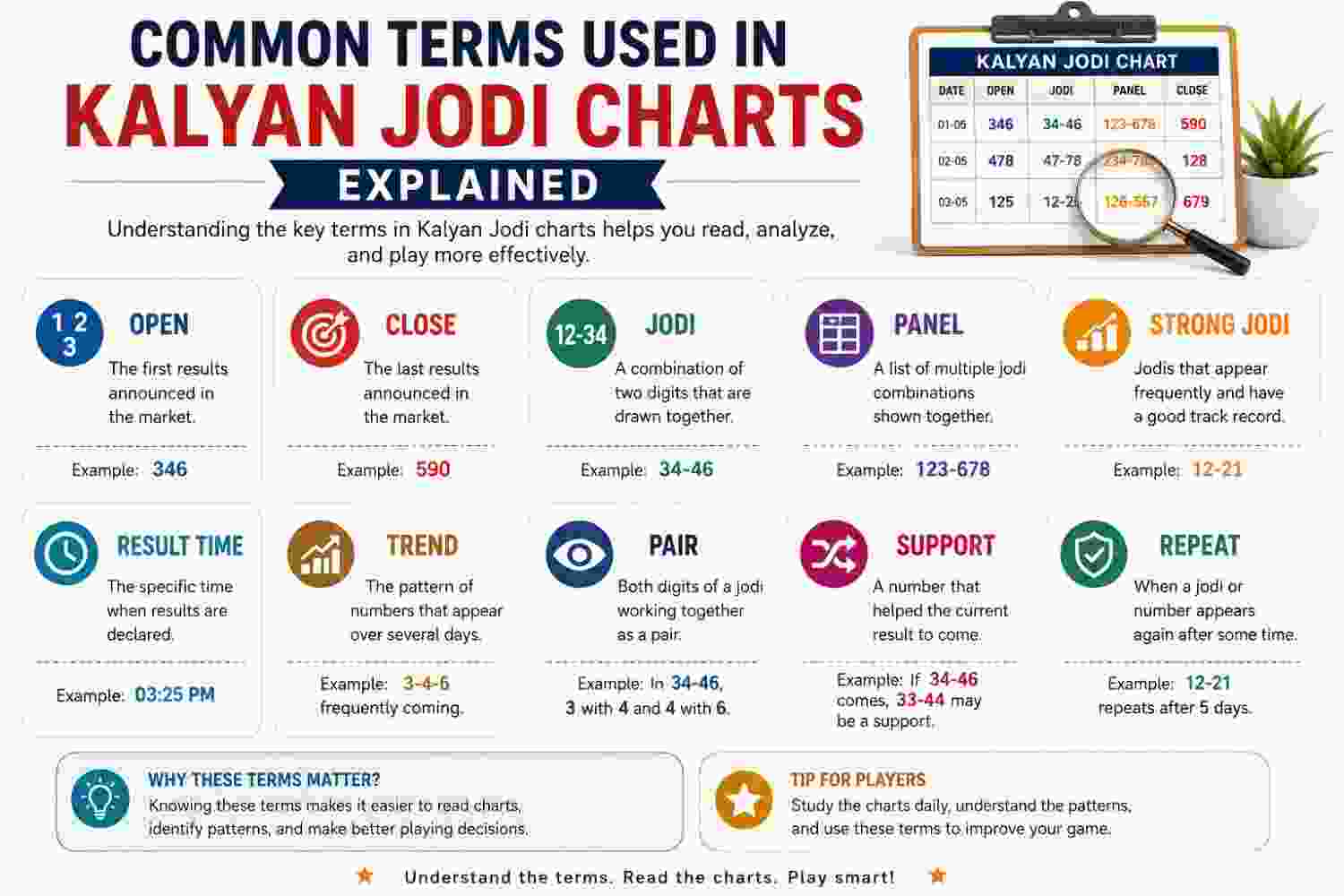
Kalyan Jodi charts contain compact numerical records that can look confusing when readers first encounter their layout. Familiarity with the vocabulary makes the displayed information easier to read without treating past numbers as a reliable forecast of future outcomes. A typical Kalyan Jodi chart may show dates, paired digits, panel numbers, opening figures, closing figures, and symbols arranged in rows or columns. Each expression has a specific role within the chart format. Knowing these distinctions helps readers interpret historical entries accurately, recognise common notation, and avoid confusing one number category with another.
Why Kalyan Jodi Chart Terminology Matters?
Chart
Charts may differ in appearance. Some use grids, while others place opening and closing information in separate columns. Additionally, blank spaces may indicate unavailable, unpublished, or non-applicable entries depending on the layout.
Result
A result refers to the numerical outcome recorded for a particular session or date. Depending on the format, the displayed result may include a panel, a single digit, a Jodi, or several related figures.
Therefore, readers should check the column heading before interpreting a number. A two-digit entry and a three-digit entry usually represent different categories even when they appear on the same row.
Core Number Terms in a Kalyan Jodi Chart
Several expressions describe the numerical units that appear repeatedly in a Kalyan Jodi chart. Although these units relate to one another, they do not mean the same thing.
For clarity, readers should distinguish the basic single digit from paired digits and three-digit panels. This distinction makes the chart's internal structure much easier to follow.
Single or Ank
A single, sometimes called Ank, is one digit from 0 through 9. In chart notation, the single may be derived from the digits of a three-digit panel according to the format used for recording the result.
For example, a chart may display a three-digit figure alongside a single digit. The single acts as a separate component rather than a shortened way of writing the panel.
Consequently, a reader should not assume that the first or last digit of a panel automatically represents the single. The chart convention determines how the displayed figures relate.
Jodi
Jodi means a pair. In this context, it generally refers to a two-digit combination formed from an opening single and a closing single.
For instance, if a displayed opening single is 4 and the closing single is 7, the associated Jodi appears as 47. The first digit represents the opening side, while the second represents the closing side.
A Jodi can range from 00 to 99. Moreover, leading zeroes matter. Therefore, 05 differs from 50, and readers should preserve the order exactly as displayed.
Jodi Chart
A Jodi chart records paired results across multiple dates or sessions. The Kalyan Jodi chart often places dates or weekdays beside the corresponding two-digit entries, allowing readers to locate historical results efficiently.
However, historical repetition does not establish a dependable predictive relationship. Each recorded pair belongs to its own listed session. Consequently, the chart works best as a reference for checking what was recorded, not as evidence that a repeated sequence must continue.
Opening and Closing Terms
Many chart layouts divide a result into opening and closing stages. These labels identify position and sequence, so they play an important role in reading paired entries correctly.
Additionally, opening and closing information may appear beside corresponding panels. Readers should follow the heading structure rather than relying only on where a number sits visually.
Open
Open refers to the opening side of a recorded result. Depending on the chart layout, an open entry may include an opening panel and the single associated with that side.
In a two-digit Jodi, the opening single occupies the first position. Therefore, in 36, the opening digit is 3, and the closing digit is 6.
Some records abbreviate opening information. Consequently, readers should distinguish an open single from an open panel because one contains a single digit while the other generally contains three digits.
Close
Close refers to the closing side of the result. It commonly includes a closing panel and its associated single in detailed chart formats.
Within a Jodi, the closing single appears in the second position. Thus, 36 carries 6 as its closing digit.
The words open and close describe the two sides of the recorded sequence; they do not mean that a chart itself has opened or closed. Moreover, a missing closing value may simply indicate that the record is incomplete at the point being viewed.
Open Jodi and Close Jodi
Some informal chart discussions use expressions such as open Jodi or close Jodi. Their meaning can vary with local usage and presentation style. Therefore, readers should inspect the surrounding labels before assigning a fixed definition.
Standard chart reading usually treats Jodi as the completed two-digit pair formed by opening and closing singles. Consequently, labels that depart from this structure require extra context.
Panel, Patti, and Panna Terminology
Three-digit combinations form another major part of many traditional chart layouts. Several names may refer to these combinations, including panel, Patti, and Panna.
Although usage can differ between communities, these words often describe closely related or equivalent three-digit entries. Therefore, context remains important when a chart uses more than one label.
Panel
A panel generally refers to a three-digit number associated with either the opening or closing side. Examples of the format include entries such as 123, 450, or 667, although the permitted structure depends on the convention being used.
A detailed row may contain an opening panel, opening single, closing single, and closing panel. Consequently, the panel provides more numerical detail than the two-digit Jodi alone.
Readers should copy all three digits accurately. A change in digit order creates a different displayed panel, even when the same digits appear.
Patti
Patti is another commonly used name for a three-digit combination. In many contexts, readers use Patti and panel interchangeably.
However, specialised lists may classify Pattis according to digit patterns. Therefore, the surrounding category label can carry additional meaning beyond the three digits themselves.
When reading a Kalyan Jodi chart, the safest approach involves identifying whether the three-digit entry appears on the opening or closing side and then reading its category only from the chart's stated notation.
Panna
Panna also commonly refers to a three-digit numerical combination. Some chart formats prefer Panna, while others use panel or Patti.
Consequently, a newcomer may encounter different words for similar chart components. The practical distinction often comes from the chart's own headings rather than from the vocabulary alone.
Date, Day, Week, and Session Labels
Numbers become meaningful as historical records only when readers connect them with the correct date or session. Consequently, chart navigation terms deserve as much attention as number terminology.
A kalyan jodi chart may arrange records chronologically, by weekday, or in weekly blocks. Therefore, checking both row and column headings prevents accidental cross-reading.
Date
The date identifies when a particular record belongs in the chart. It may appear in day-month-year, day-month, or another compact format.
Readers should verify the date format before comparing entries. For example, a compact numeric date can become ambiguous when the chart does not clearly indicate whether the day or month appears first.
Day
Some charts display weekday names or abbreviations beside results. This structure helps readers scan recurring weekly positions.
However, the weekday functions only as an organisational label. It does not establish that the same numerical result has a greater likelihood of appearing on the same weekday later.
Week
A weekly chart groups several daily records into one horizontal or vertical block. Depending on the layout, one row may represent a week while columns represent individual days.
Therefore, readers should confirm where each week begins and ends. Missing dates, holidays, or blank sessions can otherwise shift visual alignment and create reading errors.
Session
Session refers to the particular result period represented by an entry. A chart may separate opening and closing stages within one session or show the completed record together.
Meanwhile, archived layouts may group several sessions on one page. Clear date and position checks help keep records separate.
Zero, Leading Zero, and Double-Digit Notation
Zero causes frequent reading errors because it can appear as a valid digit, a leading digit, or part of a repeated pair. Accurate transcription matters.
For that reason, readers should preserve the exact number of displayed positions. Removing a zero can change both the category and meaning of an entry.
Zero as a Single Digit
Zero functions as one of the ten possible single digits. Therefore, it should not be treated as a space or absence of information when the chart explicitly displays 0.
A blank cell and a printed zero mean different things. The blank may represent missing data, whereas 0 represents a recorded digit.
Leading Zero in a Jodi
A pair such as 04 contains two positions and must remain 04. Writing it as 4 removes the opening zero and no longer preserves the Jodi format.
Similarly, 04 and 40 represent different ordered pairs. Consequently, digit position matters as much as digit identity.
Double Jodi
The expression double Jodi commonly refers to a pair with identical digits, such as 00, 11, 22, 33, and continuing through 99.
This label describes the appearance of the pair. It does not mean a result has been doubled mathematically, nor does it establish anything about future occurrence.
How the Main Terms Relate to One Another
The easiest way to read chart vocabulary involves seeing the terms as parts of one structured record rather than isolated expressions.
A detailed entry can contain two three-digit panels and two single digits. The two singles then appear together as the Jodi. Meanwhile, the date identifies where that completed record belongs.
Typical Relationship Between Components
A simplified conceptual sequence looks like this:
- Opening panel: the three-digit entry on the opening side.
- Opening single: the single digit associated with that opening side.
- Closing single: the corresponding digit on the closing side.
- Closing panel: the three-digit entry on the closing side.
- Jodi: the ordered pair formed by the opening and closing singles.
This structure explains why a Jodi cannot replace a panel and why a panel cannot be read as a Jodi. Moreover, each component occupies a different role within the same recorded result.
Why Position Matters
Position determines meaning. A digit in the opening position does not carry the same chart role as that digit in the closing position.
Similarly, reversing 27 to 72 changes the ordered pair. Therefore, readers should copy results from left to right according to the chart headings rather than rearranging digits.
Frequently Confused Kalyan Chart Terms
Several labels sound similar enough to create mistakes. Clear distinctions improve chart literacy and make historical records easier to check.
Moreover, confusion often arises because the same everyday word, such as single, can describe different numerical ideas depending on context.
Single Versus Single Panna
Single usually means one digit, such as 6. Single Panna, however, refers to a three-digit panel category in which the digits follow the relevant non-repeating structure.
Therefore, the added word Panna changes the meaning substantially.
Jodi Versus Panel
A Jodi contains two digits and represents the opening and closing singles as an ordered pair. A panel contains three digits and belongs to one side of the result.
Consequently, 24 has a different structural role from a three-digit entry such as 248.
Open Versus Opening Panel
Open can refer broadly to the opening side or specifically to the opening single, depending on context. Opening panel refers to the three-digit combination on that side.
Therefore, readers should use column headings to determine which meaning applies.
Close Versus Closing Panel
Close similarly identifies the closing side or closing single in many layouts. Closing panel identifies the corresponding three-digit entry.
The distinction becomes especially important when a row displays both figures close together.
Conclusion
Common Kalyan chart vocabulary becomes easier to read once each numerical category has a clear role. Singles represent individual digits, Jodis combine opening and closing singles, and panels or Pattis represent three-digit entries. Meanwhile, dates, sessions, symbols, and blank cells organise the historical record. Accurate reading requires attention to position, digit order, leading zeroes, and chart-specific notation. Most importantly, a Kalyan Jodi chart records past displayed results; terminology can clarify that record, but historical patterns cannot guarantee future numerical outcomes.
FAQs
What does Jodi mean in a Kalyan Jodi chart?
Jodi refers to an ordered two-digit pair, generally combining the opening single and closing single. The first digit represents the opening position, while the second represents the closing position. Therefore, order matters: 28 and 82 are different pairs, and a leading zero should remain visible.
What is a panel in a Kalyan chart?
A panel generally means a three-digit combination associated with either the opening or closing side of a recorded result. Some formats also call it Patti or Panna. Readers should distinguish panels from Jodis because panels contain three digits, while Jodis contain two ordered single digits.
What is the difference between open and close?
Open identifies the opening side of a recorded session, while close identifies the closing side. In a Jodi, the first digit represents the opening single and the second represents the closing single. Detailed charts may also display separate three-digit opening and closing panels beside those singles.
What does Ank mean in chart terminology?
Ank generally means a single digit from 0 to 9. It can represent the single associated with an opening or closing panel. Because “single Panna” describes a different three-digit category, readers should use the surrounding label to distinguish a one-digit Ank from a panel classification.
Are Patti, Panna, and panel the same thing?
These expressions often refer to three-digit combinations and may appear interchangeably in common chart vocabulary. However, usage can differ by format or convention. Therefore, readers should rely on the headings and legend of the specific chart when a layout assigns a narrower meaning to any one label.
What does double Jodi mean?
Double Jodi commonly describes a two-digit pair containing the same digit twice, such as 11, 44, or 77. The expression classifies the pair's appearance; it does not mean mathematical doubling. Additionally, the label does not indicate that such pairs follow a predictable future schedule.
Why do some Jodis begin with zero?
Zero can occupy either position in a two-digit Jodi. Consequently, a pair such as 06 must retain its leading zero because 06 and 60 represent different ordered pairs. Removing the zero changes the format and can cause readers to misidentify the recorded opening and closing positions.
Does a blank chart cell mean zero?
No. A printed 0 represents an actual digit, whereas a blank cell contains no displayed value. Depending on the chart, a blank may indicate missing information, an unrecorded session, or another formatting condition. Therefore, readers should never replace a blank automatically with zero without explicit notation.