
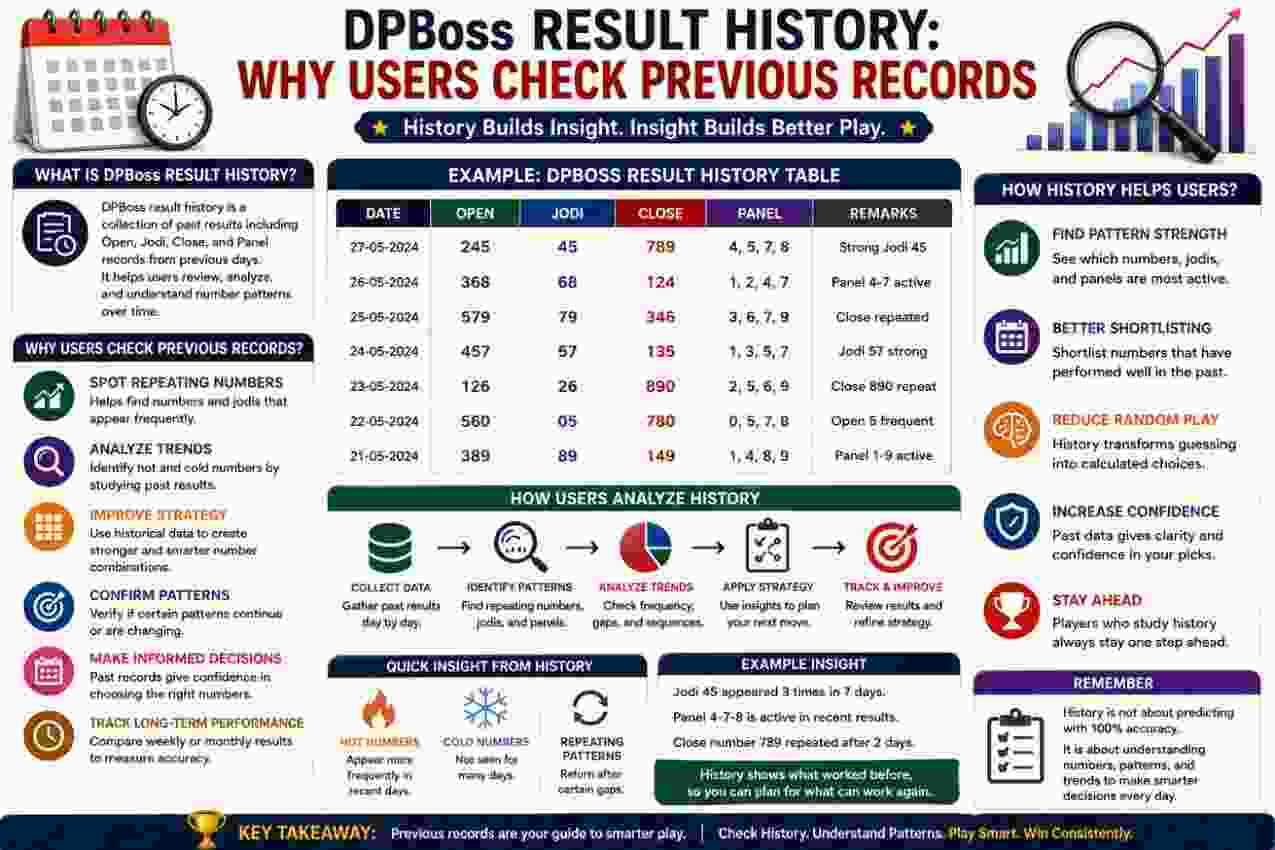
Historical numerical records often provide valuable context that a single entry cannot offer. Many readers review previous data to compare sequences, identify recurring layouts, and examine changes across different periods. Moreover, organized result history improves navigation and supports a more systematic reading process. Careful observation of records helps readers interpret structured information with greater clarity while avoiding confusion created by isolated entries.
What Is DPBoss Result History?
Result history refers to an organized collection of previous numerical records presented in chronological order. DPBoss result history allows readers to move through older entries without searching individual dates separately.
Rather than displaying only the latest information, historical records create a continuous sequence that supports comparison across multiple periods. Consequently, readers gain a broader view of numerical organization.
Most history sections follow a predictable layout that includes dates and corresponding values. Moreover, consistent formatting makes navigation easier and reduces unnecessary effort when locating specific records.
Because information remains organized, reviewing older entries becomes faster and more efficient.
Why Do Previous Records Matter?
Historical records provide context that current information alone cannot present. Therefore, many readers examine earlier entries before reviewing recent ones.
Several reasons explain this practice:
- Compare values across different dates
- Observe long-term numerical sequences
- Review organized historical data
- Locate specific records quickly
- Examine recurring layouts
- Improve familiarity with chart structure
- Track chronological progression
- Support structured observation
Consequently, previous records create a clearer picture of numerical organization while improving overall readability.
How Does Historical Data Improves Comparison?
Comparing isolated values often provides a limited perspective. In contrast, reviewing multiple historical records creates stronger context for observation.
Chronological presentation allows readers to follow information naturally from one period to another. Moreover, organized sequences simplify comparisons without requiring additional interpretation.
When records remain consistent in format, readers can focus on visible patterns instead of adjusting to changing layouts. Therefore, historical organization contributes significantly to easier comparison and smoother navigation.
A structured history section also reduces confusion by presenting related information within a single sequence.
The Importance of Chronological Order
Chronological arrangement forms the foundation of effective result history.
Every record occupies its proper position according to date, allowing readers to move through information logically. Consequently, reviewing historical entries becomes more systematic.
Chronological organization provides several advantages:
- Easy timeline review
- Better sequence recognition
- Faster location of older records
- Organized navigation
- Improved comparison between dates
- Consistent reading flow
Because each entry remains connected to its place in time, readers can review information without unnecessary interruption.
Why Do Readers Return to Older Records?
Many people revisit historical records instead of checking only current entries. Moreover, previous data often provides valuable context for comparison and observation.
Some readers examine earlier sequences to review organization, whereas others verify older information before continuing with newer records.
Returning to previous entries also helps readers become more familiar with chart layouts. Consequently, repeated observation improves navigation speed and supports a more structured reading process.
Rather than relying on memory alone, many readers prefer reviewing recorded history for greater clarity and consistency.
Pattern Observation Through Historical Records
Reviewing historical data allows readers to examine how numerical entries appear across different periods. However, meaningful observation requires attention to complete records instead of isolated values.
Many readers compare several rows together because organized sequences provide greater context. Moreover, repeated layouts become easier to recognize when viewed across a longer timeline.
Instead of moving randomly through the history section, a sequential approach improves consistency and reduces unnecessary confusion. Consequently, readers can evaluate information with greater clarity.
Careful observation supports a structured review process while maintaining focus on visible records rather than assumptions.
Benefits of Reviewing Previous Results
Historical records provide more than archived information. Therefore, many readers include previous entries in their regular review process.
Key benefits include:
- Better chronological comparison
- Improved navigation through records
- Easier location of specific dates
- Stronger awareness of chart organization
- Faster recognition of recurring layouts
- Clearer interpretation of structured information
- Reduced reading mistakes
- Greater consistency during review
Moreover, these advantages help readers approach numerical data with a more organized perspective.
How Does Organized History Improve Readability?
A clear layout influences how quickly readers interpret information.
Historical sections generally arrange records in a predictable order, allowing readers to move naturally from one entry to another. Consequently, locating older values becomes much simpler.
Proper spacing, aligned rows, and consistent formatting also improve readability. In contrast, scattered information often slows navigation and increases the possibility of error.
When readers know where each element appears, they spend less time searching and more time reviewing complete records.
Common Reasons for Checking Older Entries
Different readers review historical records for different purposes. Nevertheless, several motivations remain common across most users.
Date Comparison
Readers frequently compare values from different dates to review chronological progression.
Record Verification
Older entries help confirm previously viewed information and reduce uncertainty.
Layout Familiarity
Repeated observation increases comfort with the chart structure and improves navigation.
Sequence Review
Viewing multiple records together creates a broader perspective than examining a single entry.
Each of these reasons highlights the value of maintaining organized historical information.
Mistakes to Avoid While Reviewing History
Although the result history appears straightforward, several habits can reduce reading accuracy.
Common mistakes include:
- Skipping dates while comparing records
- Reading rows out of sequence
- Ignoring chart headings
- Comparing unrelated sections
- Focusing on one value without context
- Misreading grouped layouts
- Overlooking chronological order
- Assuming missing information
Avoiding these practices creates a more reliable and efficient review process.
Effective Methods for Reviewing Historical Records
Consistency improves interpretation and supports better navigation through large collections of data.
Readers can follow this simple process:
- Identify the starting date
- Read records in sequence
- Compare complete rows
- Check corresponding labels
- Observe surrounding entries
- Continue chronologically
- Verify information before comparison
Moreover, following the same routine regularly reduces avoidable mistakes and strengthens familiarity with the layout.
How Does DPBoss Result History Support Structured Reading?
The organization found within DPBoss's result history allows readers to review information in a logical sequence rather than jumping between unrelated records.
Chronological presentation simplifies navigation, whereas consistent formatting improves readability across multiple entries. Consequently, readers can compare previous records more effectively while maintaining proper context.
Instead of relying on scattered information, an organized history section provides a stable framework for reviewing numerical data with greater clarity and consistency.
Building Better Reading Habits with Historical Records
Strong reading habits improve the way readers interpret organized numerical information. Therefore, reviewing previous records carefully creates a more disciplined approach to chart analysis.
Instead of scanning information, readers benefit from following a consistent process. Moreover, attention to detail reduces confusion and supports more reliable comparisons.
A practical routine may include:
- Read chart headings first
- Locate the correct date
- Review complete rows
- Compare related entries
- Check surrounding records
- Continue in chronological order
- Confirm information before moving ahead
Following these steps regularly creates greater familiarity with historical layouts and improves overall reading efficiency.
How Consistent Layouts Improve Navigation?
Predictable formatting plays an important role in helping readers locate information quickly.
When every record follows the same structure, readers spend less time searching and more time reviewing the content itself. Consequently, navigation becomes smoother across long collections of historical data.
Consistent layouts also reduce visual clutter by placing information in expected positions. In contrast, changing formats may interrupt reading flow and create unnecessary confusion.
Because organized presentation supports faster recognition, readers often complete their review process with greater accuracy and confidence.
Choosing a Systematic Approach
Reviewing historical records becomes more effective when readers follow an organized method instead of relying on random observation.
Several practices contribute to a systematic approach:
Stay Within One Timeline
Reading records chronologically preserves context and improves comparison.
Avoid Isolated Interpretation
Complete rows provide more meaningful information than individual values viewed alone.
Maintain Reading Consistency
Following the same sequence each time strengthens familiarity with the chart structure.
Focus on Visible Information
Careful observation of recorded data prevents confusion caused by assumptions.
Applying these habits supports a clearer and more reliable review process.
Conclusion
Reviewing historical records offers valuable context that supports clearer interpretation and more organized comparison. Moreover, structured layouts, chronological order, and consistent formatting make navigation easier across large collections of numerical information. By following a systematic reading process and paying attention to complete records, readers can evaluate DPBoss's result history with greater clarity, accuracy, and confidence while maintaining an efficient and disciplined approach.
FAQs
1. Why do readers check previous DPBoss result records?
Many readers review previous DPBoss result records to compare chronological entries, verify historical information, and examine organized layouts. Looking at earlier data provides broader context than reviewing only the latest record.
2. What is the result history?
Result history is a chronological collection of past numerical records presented in an organized format. It allows readers to review earlier entries quickly while maintaining a logical sequence for easier navigation and comparison.
3. Why is chronological order important?
Chronological order preserves the natural progression of records and prevents confusion between unrelated dates. Consequently, readers can compare information accurately while maintaining proper context throughout the review process.
4. How does organized history improve readability?
Organized historical records into consistent layouts with predictable formatting. Moreover, aligned rows and structured presentation reduce searching time and help readers locate information more efficiently.
5. What mistakes should readers avoid?
Readers should avoid skipping dates, ignoring headings, comparing unrelated sections, reading rows out of sequence, and focusing only on isolated values. These mistakes often reduce clarity and lead to inaccurate interpretation.
6. Why do complete rows matter during comparison?
Complete rows provide surrounding context that individual values cannot offer. Therefore, reviewing the entire record creates more meaningful comparisons and improves the overall interpretation of historical information.
7. Does repeated review improve chart reading?
Yes. Repeated observation increases familiarity with chart organization, strengthens navigation skills, and supports quicker identification of historical records without changing the reading process.
8. How can readers review historical records more effectively?
Readers should follow chronological order, read headings first, compare equivalent sections, verify dates, and examine complete rows. Moreover, consistency helps reduce avoidable mistakes during review.
9. Why do many readers prefer organized history sections?
Organized history sections simplify navigation by arranging records predictably. Consequently, readers can locate specific dates, compare information efficiently, and review larger collections without unnecessary confusion.
10. What makes historical records valuable?
Historical records provide continuity, improve comparison, and support structured observation across different periods. Rather than relying on isolated entries, readers gain a broader perspective through organized chronological information.