
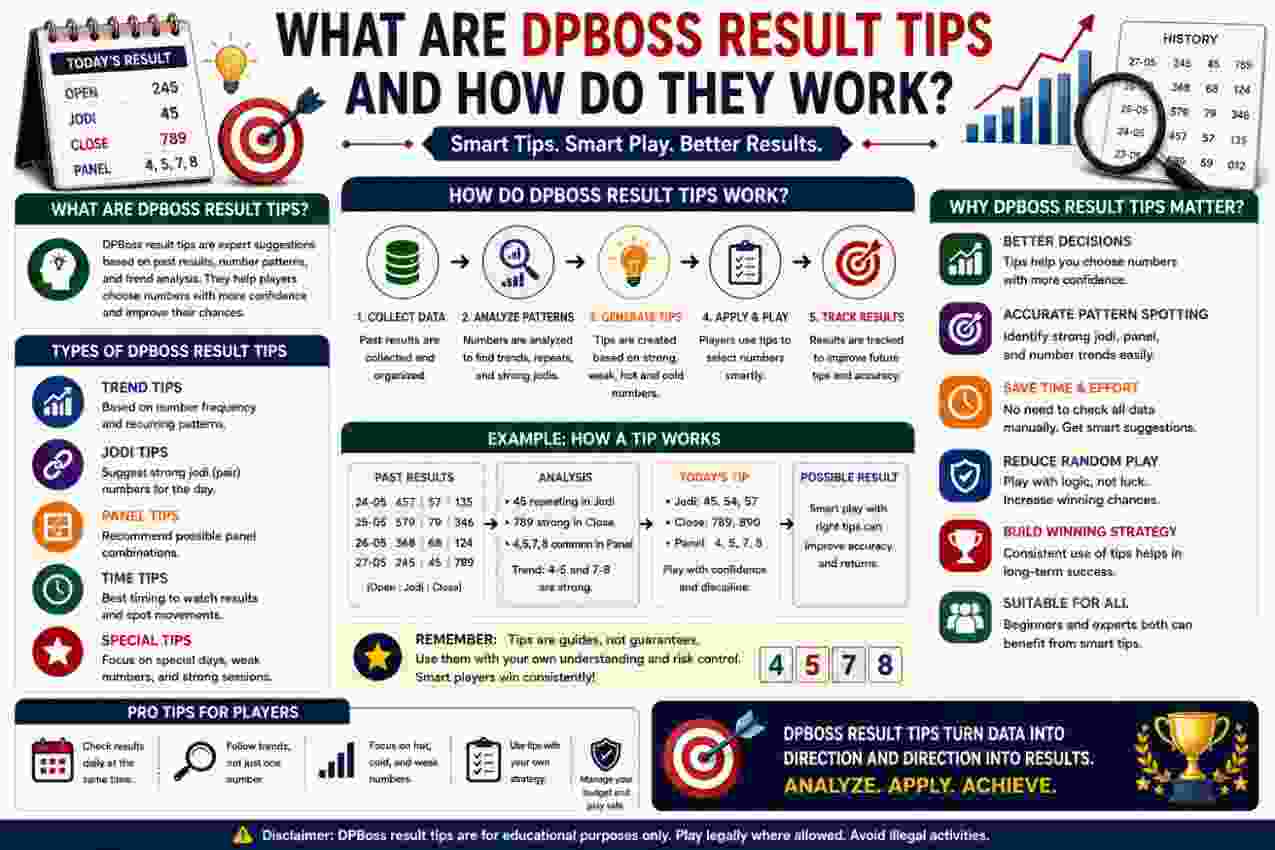
Dpboss Satta result tips generally refer to number suggestions, pattern observations, or informal predictions created from previous result records. People may study earlier panels, singles, jodis, repeated digits, gaps, and frequency patterns before forming these suggestions. However, a tip does not change the uncertainty of a future result or create a guaranteed outcome.
The practical value of examining such tips lies in recognizing how they are formed and where their limits begin. Historical data can describe previous events clearly, but it cannot prove that a similar number, sequence, or combination must appear again.
What Are Dpboss Satta Result Tips?
Result tips are informal numerical suggestions based on observations rather than guaranteed information. They may come from previous result charts, recurring digits, panel combinations, frequency counts, or perceived sequences. Consequently, two people reviewing the same historical data may produce completely different suggestions.
A tip may contain a single digit, a pair of digits, a three-digit panel, or several possibilities. However, its format does not make it more reliable. The suggestion still depends on assumptions about what historical information might mean for an uncertain future event.
How Tips Differ From Recorded Results
A recorded result describes an outcome that has already occurred. Therefore, users can verify it against a date, market, or result period.
A tip points toward an outcome that has not happened yet. Consequently, no historical record can confirm the tip beforehand.
This distinction matters because result pages often place historical information and predictions close together. Readers should keep three categories separate:
- Confirmed past results
- Numerical observations
- Unverified future suggestions
- Personal interpretations of patterns
- Promotional claims about certainty
Clear separation prevents speculation from appearing as established fact.
Why People Look for Result Tips
Numbers naturally invite comparison. When people see long result histories, repeated values and unusual sequences can attract attention.
Moreover, uncertainty encourages some users to search for patterns that appear to reduce randomness. A tip can feel useful because it converts a large set of historical numbers into a smaller selection.
That simplification can create confidence, but confidence does not equal predictive accuracy. Therefore, users should evaluate tips as interpretations rather than factual forecasts.
How Are Result Tips Commonly Created?
Different methods can produce different conclusions. Accordingly, no single historical approach creates a guaranteed forecast.
Frequency-Based Observations
One common approach involves counting how often a digit or combination appeared during a selected period.
Both conclusions introduce assumptions. A high past frequency does not prove continued frequency, while a long absence does not force a number to appear next.
Consequently, frequency can accurately describe history without predicting the future.
Gap-Based Observations
Some tips focus on the number of result periods since a particular digit or combination last appeared. A long gap may attract attention because people can interpret it as unusual.
However, the belief that an absent number becomes increasingly due can reflect the gambler's fallacy. Independent uncertain outcomes do not owe compensation for earlier sequences.
Therefore, gap data can show elapsed time between historical appearances, but it cannot establish when another appearance will occur.
Repeat and Rotation Patterns
How Historical Results Influence Tips
Historical result charts provide the raw material for many tip-making methods. They organize past outcomes by date and category, allowing users to compare entries efficiently.
Still, an archive only records completed events. Consequently, the value of historical data depends on the question being asked.
What Historical Data Can Show
Past records can accurately show:
- Which numbers appeared
- When specific results occurred
- How often values appeared within a chosen sample
- Whether a combination repeated
- How long a historical gap lasted
- Which opening and closing results were recorded
These observations remain factual when users describe only the available record.
What Historical Data Cannot Prove
Past results cannot establish that a particular future number must appear. Moreover, a sequence that looks unusual does not automatically contain predictive information.
A chart can contain clusters, repetitions, streaks, and gaps simply because uncertain sequences often produce visually striking arrangements.
Therefore, users should avoid treating historical appearance as evidence of future certainty.
Sample Size Also Matters
Small samples can exaggerate apparent patterns. A digit may seem unusually frequent across ten results but appear ordinary across hundreds of entries.
Meanwhile, selecting only the period that supports a preferred conclusion can create misleading impressions.
A larger historical sample provides better descriptive context. Even so, additional history does not turn uncertain future outcomes into guaranteed ones.
Common Types of Dpboss Satta Tips
Tips can appear in several numerical formats. The format usually reflects the type of result a person wants to discuss rather than the reliability of the suggestion.
Recognizing these categories helps readers separate different claims and avoid confusing one numerical format with another.
Single-Digit Tips
A single-digit tip usually suggests one or several numbers from 0 through 9. People may create these suggestions by studying digit frequency, gaps, or relationships with previous panels.
Because the choice set appears small, single-digit predictions can feel more manageable. However, a shorter list does not create certainty.
Jodi-Based Tips
Jodi tips involve two-digit combinations. Some people derive them from opening and closing singles, while others compare previous pairs for repetitions, reversals, or neighboring combinations.
For instance, a historical pair may inspire attention toward a reversed or related pair. Nevertheless, such transformations represent human-selected rules rather than proven forecasting mechanisms.
Panel-Based Tips
Panel tips involve three-digit combinations. Users may compare digit sums, repeated numbers, panel families, or earlier combinations when creating these suggestions.
Because panels contain more digits, they can support many possible pattern interpretations. Consequently, different observers can derive numerous conflicting tips from the same historical chart.
Open and Close Tips
Some predictions focus specifically on opening or closing result components. People may analyze the two portions separately because historical charts frequently display them in distinct columns.
However, separating categories only changes the structure of the analysis. It does not guarantee that a chosen observation will predict the next result.
Why Do Some Tips Appear Convincing?
Result tips can feel persuasive even when they lack predictive evidence. Several psychological effects make numerical patterns appear more meaningful than they actually are.
Recognizing these effects helps readers evaluate Dpboss Satta claims more carefully.
Confirmation Bias
Confirmation bias occurs when people notice information that supports an existing belief while giving less attention to conflicting evidence.
For example, someone who expects a repeated digit may remember the occasion when repetition occurred but overlook multiple occasions when it did not.
Consequently, a method can appear more successful in memory than it performs across a complete record.
Pattern Recognition
People naturally detect patterns in visual and numerical information. This ability helps with many everyday tasks, but it can also produce meaningful-looking connections within random or uncertain sequences.
Repeated digits, symmetrical combinations, and alternating values often stand out strongly. However, visual appeal does not prove predictive power.
Selective Reporting
A person may highlight successful tips while leaving unsuccessful suggestions unmentioned. As a result, readers receive an incomplete picture of performance.
Reliable evaluation requires examining all predictions made under the same stated method, including failures. Otherwise, a few memorable matches can create an exaggerated impression of accuracy.
Hindsight Effects
After a result becomes known, earlier numbers may suddenly appear connected to it. People can identify relationships that seemed less obvious beforehand.
This hindsight effect makes past outcomes look easier to predict than they actually were.
Therefore, any meaningful test of a forecasting method must define its rules before the result appears.
How Can Users Evaluate Result Tips Critically?
Critical evaluation focuses on evidence, consistency, and transparency. Instead of asking whether a tip looks appealing, readers should consider how someone produced it and whether the claimed method has been tested fairly.
This approach reduces the influence of selective examples and emotional reasoning.
Ask What Evidence Supports the Claim
A credible explanation should distinguish historical observation from future prediction.
If someone claims that a specific pattern produces reliable results, readers should ask whether the claim includes:
- A clearly defined method
- A fixed evaluation period
- Every prediction, not only successful ones
- A meaningful sample size
- Consistent rules applied before outcomes
- No guarantee language
Without these elements, accuracy claims become difficult to evaluate.
Watch for Guaranteed-Result Language
No tip should be treated as guaranteed merely because it uses charts, calculations, historical frequencies, or technical-looking language.
Terms such as fixed, sure, confirmed, or guaranteed can create an unjustified impression of certainty when applied to future uncertain results.
Therefore, readers should separate confidence in presentation from evidence of actual predictive ability.
Check Whether Rules Change After Results
A method becomes difficult to test when its rules change whenever a prediction fails.
For example, someone might use frequency after one result, gaps after another, and reversed numbers after a third. This flexibility allows almost any outcome to receive a retrospective explanation.
Consistent predeclared rules provide a fairer basis for evaluating claims.
Why Past Success Does Not Guarantee Future Accuracy
A tip can match a result occasionally without proving that the underlying method works. Chance alone can produce successful predictions, particularly when many numbers or combinations receive attention.
Moreover, people tend to remember successful matches more vividly than ordinary misses.
A Single Match Proves Very Little
Suppose a person suggests several possible numbers and one later appears. That match may attract attention, but it does not reveal whether the method performs better than chance.
Evaluation requires repeated testing under the same conditions.
Additionally, broad prediction sets increase the possibility that at least one suggestion will match while reducing the practical meaning of the claim.
Winning Streaks Can Occur by Chance
Short streaks can appear impressive. However, uncertain processes naturally produce runs of similar outcomes from time to time.
A few successful calls do not demonstrate a stable forecasting advantage.
Consequently, users should avoid assuming that a recent streak will continue indefinitely.
Losses Matter as Much as Hits
Any fair performance assessment must include unsuccessful tips alongside successful ones. Omitting failures inflates apparent accuracy.
Therefore, readers should treat screenshots, isolated examples, or selected winning records cautiously when they do not show the complete prediction history.
The Role of Probability in Result Tips
Probability helps explain why apparently meaningful sequences do not necessarily create dependable forecasts. It focuses on the likelihood of possible outcomes rather than the story attached to previous numbers.
Historical observations can describe frequency, but probability requires careful assumptions about how outcomes are generated.
Independent Outcomes and Previous Results
When outcomes operate independently, an earlier result does not force the next one to compensate for it.
For example, repeated appearances do not necessarily make another repetition impossible. Similarly, a long absence does not guarantee an immediate return.
This principle challenges many common gap-based and due-number assumptions.
Randomness Can Look Structured
Randomness does not always look evenly mixed. Short sequences can contain clusters, repetitions, long gaps, and apparent cycles.
Therefore, a chart does not need manipulation or hidden logic to contain unusual-looking patterns.
Recognizing this fact helps readers avoid assigning predictive meaning to every visually distinctive sequence.
Probability Is Not Certainty
Even a mathematically stated probability does not guarantee a specific individual outcome. Probability describes uncertainty across possible events.
Consequently, converting historical frequencies into exact future promises goes beyond what the data can justify.
Responsible Use of Dpboss Satta Information
Historical result information can serve a legitimate record-checking purpose. Users can verify earlier outcomes, compare dates, and examine how numerical formats are organized.
Problems arise when descriptive records become presented as guaranteed prediction systems.
Keep Records Separate From Forecasts
A confirmed result belongs to history. A tip belongs to speculation until the relevant outcome occurs.
Keeping these categories separate makes numerical information clearer and reduces confusion.
Users should also distinguish statistical descriptions from predictive claims. A frequent historical digit remains a historical observation unless reliable evidence establishes a forecasting relationship.
Set Practical Limits
Anyone engaging with chance-based activities should avoid treating tips as a dependable source of income or financial recovery.
Practical safeguards can include setting fixed spending limits, avoiding borrowed money, and refusing to chase previous losses.
Additionally, decisions made under stress or financial pressure can become less disciplined. Stepping away from high-pressure situations protects judgment.
Treat Paid Certainty Claims With Caution
Claims that payment unlocks guaranteed numbers deserve strong skepticism. Charging for a prediction does not make it accurate.
Likewise, private groups, exclusive access, mathematical language, or claims of insider information do not automatically establish credibility.
A responsible approach rejects guarantees where outcomes remain uncertain.
Conclusion
Dpboss Satta result tips generally come from historical frequencies, gaps, panels, jodis, repeated digits, and other numerical observations. Such methods can organize past information and explain how users form predictions, but they cannot turn historical patterns into guaranteed future outcomes.
Careful readers should distinguish verified results from speculation, examine complete performance records, and remain skeptical of certainty claims. Additionally, probability, confirmation bias, selective reporting, and chance can make weak methods appear stronger than they are. Treating result tips as unverified interpretations rather than dependable forecasts provides a clearer and more responsible view of how they work.
FAQs
What are Dpboss Satta result tips?
Dpboss Satta result tips are informal numerical suggestions created from previous results, frequency counts, gap observations, panels, singles, jodis, or perceived patterns. They represent interpretations rather than confirmed future outcomes. Historical records can support factual comparisons, but no pattern-based suggestion can guarantee that a particular number will appear next.
Do previous results make tips more accurate?
Previous results provide historical information, including frequencies, repetitions, and gaps. However, those observations do not automatically improve future prediction accuracy. A pattern can exist in past records without continuing. Therefore, evaluating any tip requires separating descriptive historical facts from unsupported assumptions about what an uncertain future result will be.
What does a hot or cold number mean?
A hot number usually describes a value that appeared frequently within a selected historical period, while a cold number appeared less often. These labels summarize past frequency only. They do not prove that a hot value will continue appearing or that a cold value has become due for a future result.
Can panel patterns guarantee the next result?
No panel pattern can guarantee a future result merely because similar combinations appeared previously. Three-digit panels can produce many repetitions, sums, reversals, and visual relationships across historical records. Those connections may support descriptive analysis, but they do not establish certainty about the next combination in an uncertain sequence.
How should users assess claims about accurate tips?
Users should look for fixed rules, complete prediction histories, clearly defined evaluation periods, and results that include both successful and unsuccessful calls. Guaranteed-result language deserves caution. Moreover, a few selected matches do not establish long-term accuracy, particularly when numerous possible numbers were suggested before the outcome.