
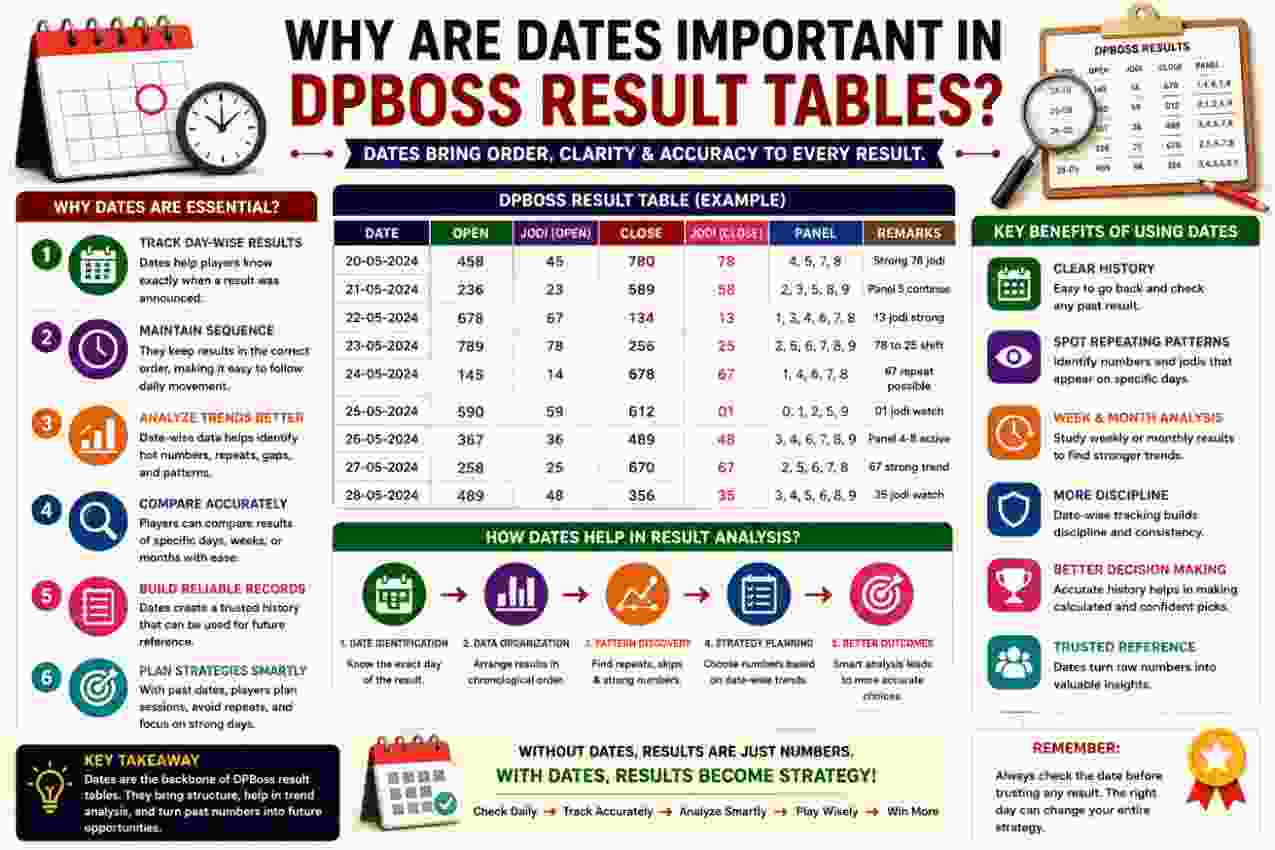
Dates give every result a fixed place within a chronological record. Without them, readers would see disconnected numbers with no reliable way to identify their session, sequence, or relevance. A Dpboss result table uses dates to separate daily declarations, organise historical entries, expose missing records, and support accurate comparisons. Clear date labels also help readers distinguish current information from archived data. Consequently, dates do more than mark time; they create the structure that makes an entire result table readable, searchable, and verifiable.
Dates Connect Results With Specific Sessions
Every result belongs to a particular operating session. A date connects that declaration with the day on which it entered the official sequence.
Numbers can repeat across different days. Therefore, the numerical value alone cannot identify a unique entry. A pair such as 47 may appear several times within a monthly or yearly record. The date separates each appearance and preserves its correct context.
One Number Can Appear on Multiple Dates
Repeated values make date labels essential. Consider a result that appears on the third, eleventh, and twenty-sixth days of a month. Although each row contains the same pair, every occurrence represents a separate session.
Without visible dates, readers could mistake three valid appearances for duplicate entries. In contrast, chronological labels confirm that each result belongs to a different day.
Dates Prevent Session Confusion
Several sessions may run across a broader daily schedule. Moreover, late declarations can appear near midnight or after an expected closing time.
A reader who checks only the clock may associate a late result with the next calendar day. The date printed in the relevant row resolves that confusion and keeps the entry attached to its intended session.
A Date Gives a Number Meaning
A standalone number provides limited information. However, a dated result communicates:
- When the declaration occurred
- Where it belongs in the sequence
- Which earlier and later results surround it
- Whether it represents a current or archived entry
- Whether another identical value counts as a repeat
Consequently, the date turns an isolated value into a usable historical record.
Chronological Order Creates a Readable Table
A result table must present information in a predictable sequence. Dates provide that sequence by arranging entries from earliest to latest or latest to earliest.
Readers can then move through the records without guessing which declaration came first. Additionally, consistent order helps them find a particular day quickly.
Ascending Date Order
An ascending table begins with the earliest date and progresses toward the latest. This structure works well for monthly and yearly archives because it mirrors the natural passage of time.
For example, a monthly record may begin on the first day and finish on the final operating date. Readers can trace the entire sequence from top to bottom without reversing their reading direction.
Descending Date Order
A descending layout places the newest entry first. This arrangement supports quick access to recently declared information.
However, readers must recognise the direction before comparing consecutive rows. A result directly below another entry may belong to the previous day rather than the following day.
Why Consistent Ordering Matters
A table that switches between ascending and descending dates can cause several problems:
- Readers may reverse result sequences.
- Repeated pairs may appear out of order.
- Missing dates become harder to identify.
- Gap calculations can produce incorrect totals.
- Monthly boundaries may seem unclear.
Therefore, a Dpboss table should maintain one ordering method throughout each section.
Dates Separate Current Results From Historical Records
Result tables often contain both recent declarations and older archives. Clear dates help readers distinguish active information from completed historical entries.
This distinction matters because an old result can remain numerically valid for its original session while holding no connection to the current schedule.
Recognising the Latest Entry
The latest date usually identifies the most recent completed result. Nevertheless, readers should also check the session status because the newest row may remain incomplete.
For example, the opening value may appear while the closing value remains pending. Consequently, the latest date does not always indicate a fully declared result.
Avoiding Outdated Information
Saved screenshots, cached pages, and copied messages may show accurate numbers from an earlier period. Without a visible date, readers cannot determine whether the information remains relevant.
A dated table exposes outdated material immediately. Moreover, it allows readers to compare the copied number with the correct historical row.
Navigating Archived Periods
Historical records may span several months or years. Dates enable readers to narrow the search through a simple hierarchy:
- Select the correct year.
- Locate the relevant month.
- Find the required day.
- Confirm the session and result.
- Check any status or correction mark.
This process prevents valid results from becoming attached to the wrong period.
Dates Support Accurate Result Verification
Verification requires more than matching two numbers. Readers must confirm that the result belongs to the correct date, session, and status.
A number may appear accurately in one row but incorrectly in another. Therefore, date matching forms a central part of every reliable check.
How to Verify a Dated Result
A practical verification routine includes these steps:
- Confirm the complete calendar date.
- Check the displayed date format.
- Locate the corresponding row.
- Read the full result from that row.
- Confirm whether the session reached final status.
- Review any correction or closure notice.
- Compare the result with the saved record.
Each step protects against a different type of error.
Why Number Matching Alone Fails
Suppose a saved note shows 38, and the historical table also contains 38. That match does not prove accuracy unless both records share the same date.
The pair may have appeared several weeks earlier. Consequently, readers must match the date and result together rather than searching only for a familiar number.
Dates Help Resolve Conflicting Records
Two personal records may display different results for one session. The date provides a common reference point for resolving the conflict.
Readers should locate that exact date, check the complete row, and review whether a later correction replaced the first value. Additionally, they should confirm that both records use the same calendar format.
Date Formats Require Careful Reading
Different tables may display dates in different orders. A format that looks obvious to one reader may create confusion for another.
For instance, 04/07 can represent either 4 July or 7 April. Clear labels and consistent formatting prevent this ambiguity.
Common Date Formats
Result tables may use formats such as:
- DD/MM/YYYY
- MM/DD/YYYY
- YYYY/MM/DD
- DD-MM-YYYY
- Month name followed by day and year
- Day followed by month name and year
Formats that spell out the month provide the greatest clarity. However, numeric formats remain readable when the table uses them consistently.
Day and Month Reversal
Dates below the thirteenth day of a month create the greatest risk of reversal. Both 05/08 and 08/05 can represent valid calendar dates.
Therefore, readers should inspect neighbouring rows or section headings before recording information. A monthly heading often reveals which number represents the month.
Year Identification
Older archives may contain identical day-and-month combinations across several years. Omitting the year can therefore connect a result with the wrong annual record.
A complete historical entry should identify the year through the row, section title, or archive heading. Moreover, readers should include the year when saving results for long-term use.
Dates Reveal Missing Entries
A chronological table should account for every expected operating date. When the sequence skips a day, the gap may indicate a closure, cancellation, delayed record, or missing entry.
Dates make such gaps visible. Without them, readers could not determine whether the table contains a complete series.
A Missing Date Is Not Always an Error
Markets may not operate on certain days because of scheduled closures, holidays, or exceptional circumstances. Consequently, an absent result does not automatically indicate faulty recordkeeping.
A reliable table should clarify the reason through a closure symbol, blank field, or status note.
Missing Date Versus Blank Result
A missing date and a blank result communicate different conditions:
- A missing date removes the entire calendar entry.
- A blank result preserves the date but shows no declared value.
- A closure symbol marks a non-operating session.
- A pending label indicates an unfinished update.
- An unavailable mark shows that confirmed information remains absent.
Maintaining these distinctions protects chronological accuracy.
Why Silent Gaps Cause Problems
Unexplained gaps can distort several forms of analysis. They may make a repeated result appear farther apart, reduce the apparent sample size, or create a false sequence between non-consecutive sessions.
Therefore, readers should identify every skipped date before calculating frequencies or intervals.
Dates Make Corrections Easier to Track
Result tables sometimes require corrections because of typing mistakes, reversed digits, misplaced rows, or delayed confirmation.
A date identifies the exact entry that needs revision. Without it, a correction notice could affect every identical number in the record.
Linking a Correction to One Row
Suppose the pair 26 appears on several dates, but only one occurrence contains an error. The correction must specify the affected day.
The date isolates that row and protects the remaining entries from unnecessary changes. Consequently, record keepers can revise one result without disturbing valid historical data.
Replacing Temporary Information
An opening-stage result may appear before the complete declaration. Later, the closing information finishes the row.
The date keeps both updates connected with the same session. Readers can then replace or extend the partial entry instead of creating a duplicate record.
Maintaining Correction Notes
A clear correction note may record:
- The affected date
- The earlier displayed value
- The confirmed replacement
- The time of revision
- The final session status
Such notes support transparency and help readers update personal records accurately.
Historical Comparison Depends on Reliable Dates
Readers often compare results across days, weeks, months, or years. These comparisons require stable date labels because every calculation depends on the selected period.
A result table without accurate dates cannot support meaningful time-based analysis.
Daily Comparisons
Daily comparison examines consecutive operating sessions. It may focus on repeated digits, reversed pairs, or changes between one result and the next.
However, readers must distinguish consecutive calendar days from consecutive operating days. A closure between two results changes the calendar interval without adding another declared session.
Weekly Comparisons
Weekly grouping allows readers to examine short sequences and recurring day patterns. Nevertheless, weeks can cross monthly boundaries.
Therefore, each entry should retain its complete date even when the table groups rows by weekday.
Monthly Comparisons
Monthly analysis may measure:
- Total operating sessions
- Frequency of particular pairs
- Number of repeated results
- Longest gaps within the month
- Missing or closed dates
- Corrections made during the period
Accurate dates ensure that every result enters the correct monthly sample.
Yearly Comparisons
Yearly archives provide broader context, but they also increase the risk of selecting the wrong period. A pair may appear on the same calendar day across different years.
Consequently, readers should confirm the year before comparing historical entries.
Dates Improve Frequency Analysis
Frequency analysis counts how often a number appears within a defined period. The calculation only becomes useful when the starting and ending dates remain clear.
Changing the date range can change the result significantly. Therefore, every frequency statement should connect with a specific sample.
Defining the Sample Period
Before counting, readers should establish:
- The first included date
- The final included date
- The number of operating sessions
- Treatment of closed days
- Treatment of missing entries
- Treatment of corrected results
This structure prevents selective counting.
Counting Valid Sessions
Calendar days and valid sessions do not always match. A 30-day month may contain fewer than 30 declared results because of closures or unavailable sessions.
Consequently, frequency calculations should use the number of valid entries rather than the total number of calendar days.
Preventing Duplicate Counts
Duplicate records can arise when the same date appears in both a current-results section and a historical archive. Counting both entries would inflate the frequency of that result.
The date exposes the duplication. Readers can then retain one confirmed entry within the chosen sample.
Keeping Claims Limited to the Sample
If a pair appears four times between two stated dates, that finding describes only that period. It does not prove that the same rate will continue.
Moreover, another date range may produce a completely different distribution. Historical frequency records past appearances without guaranteeing future behaviour.
Dates Enable Accurate Gap Measurement
A gap measures the distance between two appearances of the same pair, digit, or panel. Dates provide the reference points needed for that calculation.
However, readers must decide whether they want to count calendar days or valid operating sessions.
Calendar-Day Gaps
A calendar-day gap includes every date between two results, even when no session operated.
This method measures elapsed time. Nevertheless, it may overstate the number of actual result opportunities when closures occur.
Operating-Session Gaps
An operating-session gap counts only valid declarations between two appearances.
This method often provides clearer historical analysis because it excludes days that produced no result. Therefore, the table must mark closures and missing entries accurately.
Why Long Gaps Do Not Create Certainty
A pair may remain absent across many dates, but that absence does not make it certain to appear next. Historical gaps describe past spacing rather than future obligation.
Similarly, a pair that appeared recently can repeat without following a fixed waiting period.
Dates Preserve the Correct Result Sequence
Sequence analysis depends on order. Readers need dates to determine which value came before another and whether two entries occurred consecutively.
Without dates, any sequence could reflect accidental sorting rather than actual declaration order.
Previous and Following Results
To examine what followed a particular pair, readers must locate every dated occurrence and inspect the next valid session.
This approach prevents selective examples. Moreover, it may show that several different results followed the same pair, weakening claims about fixed sequences.
Monthly Boundaries
The final date of one month and the first date of the next remain consecutive calendar entries, although they appear in separate sections.
Readers who ignore the boundary may treat the sequence as interrupted. Therefore, broader comparisons should connect adjoining monthly records carefully.
Year-End Boundaries
A similar issue occurs between December and January. The change in year does not erase chronological continuity.
Complete dates allow readers to connect these periods while still preserving the correct annual classification.
Dates Support Better Personal Recordkeeping
Readers who maintain personal records need dates to keep entries organised. A number saved without its declaration date quickly loses context.
A consistent recording method reduces confusion and makes later verification faster.
Useful Fields for Each Entry
A practical personal record may contain:
- Full date
- Day of the week
- Opening panel
- Jodi
- Closing panel
- Session status
- Correction status
- Verification status
These fields preserve both numerical and chronological information.
Using One Date Format
Personal records should follow one format throughout. Switching between day-first and month-first styles can reverse dates and attach results to the wrong session.
Spelling out the month or using a clearly labelled format provides stronger protection against ambiguity.
Recording Closed Days
Closed days should remain visible in long-term records. A simple closure mark maintains the date sequence without adding a false result.
Additionally, visible closures help readers calculate operating-session gaps correctly.
Reviewing Entries Regularly
Periodic review can expose:
- Duplicate dates
- Missing days
- Incorrect years
- Reversed day and month values
- Results placed in adjacent rows
- Unrecorded corrections
Correcting these issues early protects the larger archive from accumulated errors.
Dates Help Readers Navigate Large Tables
A long Dpboss result table may contain hundreds or thousands of entries. Dates function as navigation points that help readers move directly to the required period.
Without chronological labels, searching would depend entirely on number matching, which fails whenever results repeat.
Finding a Specific Result
An efficient search follows this order:
- Identify the year.
- Select the month.
- Locate the day.
- Confirm the session row.
- Read the full result.
- Check its status.
This method reduces scanning time and prevents accidental selection of a similar result.
Using Month and Year Headings
Section headings divide large archives into manageable units. However, individual rows should still display enough date information to remain clear when copied or viewed separately.
A result that relies entirely on a distant heading may lose context in a screenshot. Consequently, visible row dates improve portability and verification.
Checking Neighbouring Dates
The rows immediately before and after an entry help confirm its position. If the surrounding dates do not follow a logical sequence, the reader may have entered the wrong section or encountered a sorting issue.
Common Date-Related Mistakes
Many result-recording errors originate from dates rather than numbers. Recognising these mistakes helps readers protect the accuracy of their records.
Careful checking usually prevents them.
Confusing the Publication Date With the Session Date
A result may receive publication or correction after its scheduled session. The visible update time does not necessarily replace the assigned result date.
Therefore, readers should follow the date attached to the session row.
Ignoring the Year
A day and month can repeat annually. Saving an entry without the year may create confusion when the record grows.
Moreover, yearly comparisons require complete dates to separate identical calendar positions.
Assuming Every Date Contains a Result
Closures, cancellations, and unavailable sessions can create empty rows. A blank date position should not automatically become 00 or another numerical value.
Only confirmed declarations count as valid results.
Mixing Date Formats
Copying entries from differently formatted records can reverse days and months. Standardisation should occur before combining the data.
Recording the Wrong Adjacent Row
Dense tables can make neighbouring rows appear connected. Readers should trace horizontally from the date to the result and confirm both before saving anything.
Responsible Use of Dated Result Data
Dates strengthen record accuracy, but they cannot transform historical information into guaranteed predictions. Every entry describes a completed session rather than a certain future outcome.
Responsible interpretation keeps factual records separate from speculative claims.
Past Dates Do Not Control Future Results
Repeated numbers, long gaps, weekday patterns, and monthly sequences may attract attention. However, historical timing cannot force a particular pair to appear.
A dated pattern remains an observation within a selected sample.
Financial Risk Remains Present
Number-based gambling involves financial uncertainty. Anyone who participates should protect household expenses, savings, emergency funds, and borrowed money.
Additionally, chasing losses can increase harm quickly. No date sequence or historical pattern removes that risk.
Legal Requirements Vary
Rules concerning gambling differ across jurisdictions. Readers should check the laws that apply in their location before participating.
Access to result tables does not establish legal permission.
Conclusion
Dates give Dpboss result tables their chronological structure, accuracy, and practical value. They connect every number with the correct session, separate current entries from archives, reveal missing records, support corrections, and strengthen historical comparisons. Readers should verify the full date, recognise the displayed format, account for closures, and match each result with its proper row. Although dated records support factual analysis, they cannot guarantee future outcomes. Careful date handling keeps result information organised, searchable, and reliable.
FAQs
Why should every result row include a date?
A date connects the displayed result with one specific session. It separates repeated numbers, establishes chronological order, and allows readers to verify saved records. Without a date, a valid pair could belong to several different periods, making accurate identification, comparison, correction, and long-term recordkeeping far more difficult.
How can readers avoid confusing day and month numbers?
Readers should identify the table’s stated date format before recording any result. Month headings, neighbouring rows, and four-digit years can provide additional context. Using written month names or maintaining one clearly labelled format in personal records also prevents ambiguous dates such as 04/07 from receiving the wrong interpretation.
Why do some dates show no result?
A date may remain blank because of a scheduled closure, cancellation, delayed declaration, unavailable information, or incomplete session. Readers should check any accompanying status mark rather than treating the blank as zero. Preserving the empty or closed entry helps maintain chronological continuity and supports accurate gap calculations.
Can dates help identify an incorrect result?
Yes. Readers can match the questionable value with its exact dated row, review the complete result, and check for correction notices. Dates also expose results copied from adjacent sessions or older archives. However, number matching alone cannot confirm accuracy because identical pairs may appear on several different dates.
Do repeated results on similar dates predict future outcomes?
No. Similar calendar positions, weekdays, or monthly intervals can produce visible historical patterns, but they cannot guarantee another result. Dates help describe when earlier values appeared. They do not create a causal rule that controls future declarations, even when a sequence looks regular within a selected sample.