
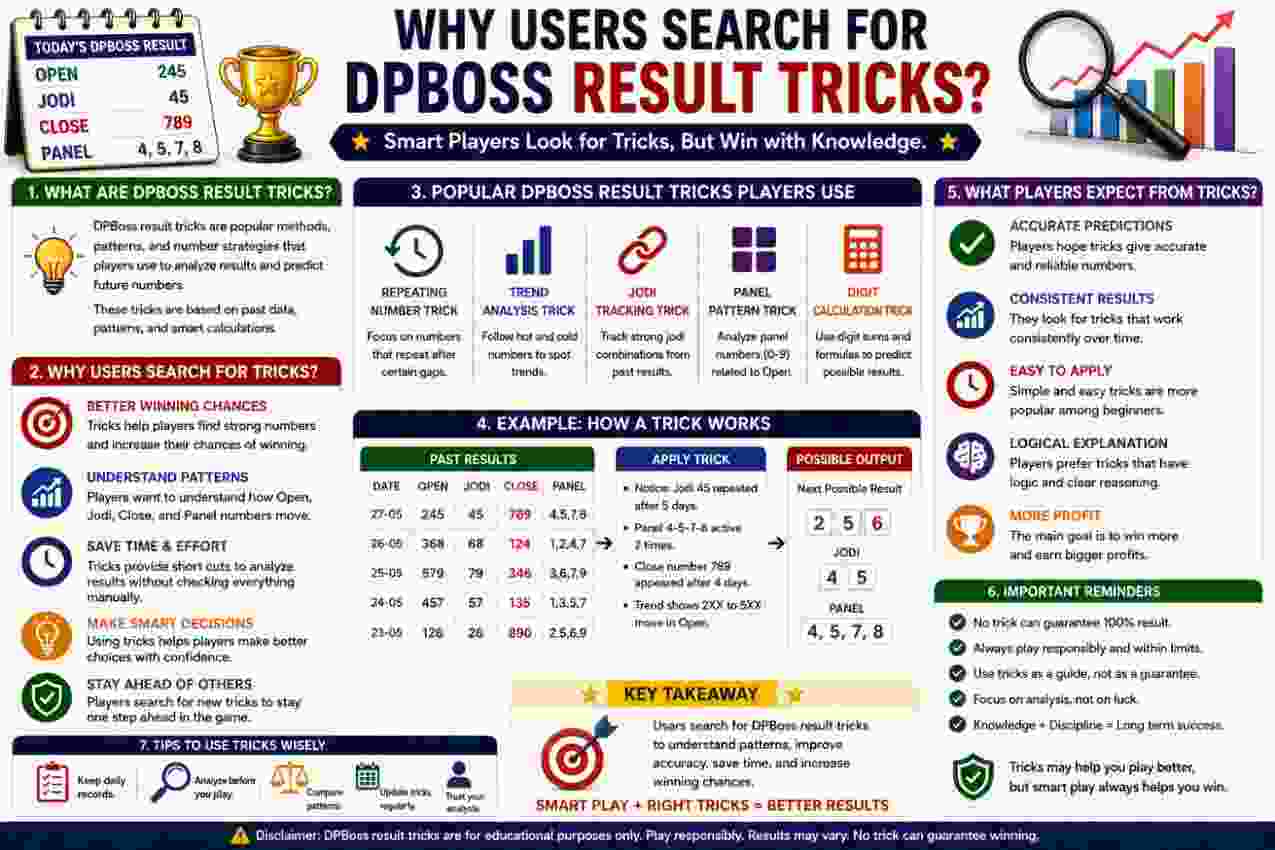
People often search for DPBoss result tricks because uncertain outcomes create curiosity, hope, and a desire for control. Charts, recurring digits, archived records, and informal predictions can make random results appear predictable. However, no method can guarantee a future number. Examining the motives behind these searches reveals how pattern recognition, social influence, emotional pressure, and misleading claims shape user behaviour around Dpboss matka information.
What Are DPBoss Result Tricks?
DPBoss result tricks usually refer to informal methods that claim to identify possible result combinations. Users may study previous records, calculate digit totals, compare opening and closing figures, or follow predictions shared through online communities.
These methods often appear systematic because they use charts, calculations, and specialised vocabulary. Nevertheless, a structured appearance does not prove predictive accuracy.
Common Methods Presented as Tricks
Searchers commonly encounter methods based on:
- Previous open and close figures
- Repeated jodi combinations
- Panel digit totals
- Missing numbers
- Weekly result cycles
- Mirror or family digits
- Market-to-market comparisons
- Informal guessing formulas
- Personal predictions
- Digit frequency tables
Some techniques simply organise historical information. Others make unsupported promises about future results. Therefore, users must separate record analysis from claims of guaranteed prediction.
Why the Word “Trick” Attracts Attention
The word “trick” suggests a shortcut that ordinary users may have overlooked. It creates the impression that someone possesses hidden knowledge capable of simplifying a difficult task. Consequently, searchers may expect a quick formula instead of a detailed review of uncertainty.
Moreover, shortcut-based language feels accessible. A person may avoid technical explanations but click immediately on content promising an easy method, fixed calculation, or secret pattern. This appeal often grows when users feel impatient or confused.
Why Do People Want Predictable Results?
Uncertain outcomes can make people uncomfortable. As a result, they seek patterns, explanations, and methods that provide a sense of order. Result trick searches frequently reflect this psychological need rather than the actual reliability of any calculation.
The Desire for Control
People naturally prefer situations where their decisions seem meaningful. When results remain uncertain, a formula can create an impression of control. Even a weak method may feel reassuring if it produces a clear number.
For example, a user might add panel digits, track a missing jodi, or compare several archived entries. The calculation supplies a definite answer, although the underlying outcome remains uncertain. Therefore, the feeling of control may exceed the method’s real value.
Hope of Finding a Shortcut
Careful record reading requires time, patience, and accurate interpretation. In contrast, a supposed trick promises speed. Users may believe one calculation can replace hours of chart review.
Additionally, shortcut claims often use confident language. Phrases that imply fixed numbers or confirmed outcomes can attract attention quickly. However, confidence does not establish reliability, and certainty-based promises deserve particular caution.
Fear of Missing Useful Information
Users may worry that others know a method they have not seen. This fear can encourage repeated searches for fresh calculations, hidden formulas, or special result signals.
Meanwhile, online discussions can intensify that concern. When several people mention the same approach, the method may appear important even without supporting evidence. Social repetition can therefore create perceived credibility.
How Pattern Recognition Drives These Searches
Human attention naturally notices repetition, symmetry, and familiar sequences. Dpboss matka charts contain many digits, making them especially suitable for pattern-based interpretation. However, visible repetition does not necessarily indicate a dependable rule.
Repeated Numbers Capture Attention
A digit that appears several times within a short period may seem significant. Users might assume that repetition will continue or, alternatively, that the digit cannot appear again soon.
Both conclusions can arise from the same record. Consequently, personal expectations often shape the interpretation more than the data itself.
Random sequences regularly contain clusters. For instance, the same digit may appear repeatedly without any hidden mechanism. A cluster can look unusual while remaining statistically possible.
Missing Digits Create Expectations
Some users focus on numbers that have not appeared for several sessions. They may believe an absent digit has become “due.” This belief resembles the gambler’s fallacy, where a person assumes previous outcomes must force a different future outcome.
However, an independent result does not carry a memory of previous records. A long absence may look meaningful, yet it does not guarantee an immediate appearance.
Symmetry Feels Deliberate
Pairs such as 22, 44, or 77 attract attention because they look organised. Likewise, reverse combinations such as 27 and 72 can appear connected. Visual neatness can make these figures feel more important than ordinary combinations.
Nevertheless, appearance alone provides no evidence of predictive power. A visually striking result remains one result among many possible combinations.
Charts Encourage Narrative Building
A large record offers enough information to support many competing explanations. One person may focus on repetition, while another tracks gaps. A third may connect results from different markets.
As a result, each user can build a convincing narrative from the same chart. This flexibility makes historical records useful for review but weak as proof of a single predictive system.
What Role Do Historical Charts Play?
Historical charts remain central to most DPBoss result trick searches. They organise past open figures, close figures, jodis, and panels in a readable format. Their strongest value lies in record verification and comparison, not guaranteed forecasting.
Charts Make Large Records Easier to Read
Without a chart, users would need to examine scattered entries individually. A structured table groups results by market, date, or session. Consequently, repeated values and missing entries become easier to spot.
Charts can help users:
- Verify an earlier result
- Compare open and close records
- Identify formatting errors
- Review weekly sequences
- Separate different market records
- Track specific jodis or panels
- Confirm whether a claim matches archived data
These uses rely on recorded facts. Prediction claims, however, move beyond what the chart can prove.
Past Data Can Look More Predictive Than It Is
Once an outcome appears, users can often find a previous pattern that seems connected to it. This process works backward: the result comes first, and the explanation follows.
For example, a commentator may select three earlier entries that support a formula while ignoring dozens that do not. The chosen examples can make the method look accurate. Therefore, users should examine the full record rather than a few successful illustrations.
Flexible Rules Produce Misleading Success
Some trick systems change their rules whenever a prediction fails. A user may switch from direct digits to mirror digits, family numbers, totals, or reversed combinations. Such flexibility makes almost any result appear related to the original prediction.
A reliable method requires clear rules before the outcome occurs. If an explanation changes afterward, it cannot provide a fair test of accuracy.
How Online Search Behaviour Reinforces Interest
Search engines respond to the phrases people enter. When many users look for quick calculations, prediction pages, and result formulas, similar suggestions become more visible. Increased visibility can then generate further curiosity.
Search Suggestions Create Perceived Popularity
Autocomplete suggestions can make a phrase seem trustworthy because many people search for it. Yet popularity does not confirm accuracy. It only indicates interest.
Moreover, users may interpret frequent searches as evidence that a working method exists. This assumption encourages deeper searching, even when available pages repeat the same unsupported claims.
Sensational Headlines Win Attention
Headlines promising fixed results, secret methods, or perfect accuracy appeal to urgency and hope. They often outperform cautious explanations because certainty attracts more clicks than probability.
However, dramatic wording should trigger scrutiny. A source that guarantees an uncertain outcome may aim primarily to capture traffic, encourage repeated visits, or influence decisions.
Repeated Claims Feel Familiar
When users encounter the same prediction method across several pages, familiarity can create trust. Psychologists describe this tendency as the illusory truth effect: repeated information may feel more credible merely because it appears familiar.
Consequently, copying and repetition can make an unsupported DPBoss result trick seem established. Independent evidence matters more than the number of pages repeating a claim.
Why Social Influence Matters
Result-related behaviour rarely develops in isolation. Friends, groups, online discussions, and informal tip providers can affect what users search for and which methods they trust.
Group Confidence Can Replace Evidence
A confident group may create a strong sense of certainty. If several members support one number or formula, an individual may accept the consensus without checking its record.
Additionally, groups tend to celebrate successful predictions more visibly than failed ones. This selective attention creates an exaggerated impression of accuracy.
Success Stories Spread Faster
A correct guess produces excitement, screenshots, and enthusiastic messages. A failed prediction usually receives less attention. Therefore, users see a distorted balance between success and failure.
One correct result may circulate widely, while twenty incorrect predictions disappear. Without a complete record, nobody can calculate the method’s actual performance.
Authority Signals Influence Decisions
Some tip providers use technical language, complex calculations, or confident presentation to appear knowledgeable. These authority signals can persuade users even when the underlying reasoning remains weak.
A professional appearance cannot replace verifiable evidence. Users should ask whether the predictor records every forecast, preserves failed calls, and states limitations clearly.
What Emotional Factors Encourage Repeated Searches?
Emotions can strongly influence result-related searches. Excitement, disappointment, urgency, and regret may lead users to seek another trick immediately, especially after an unexpected outcome.
Losses Can Trigger More Searching
After an unfavourable result, a user may believe better information could prevent another loss. Consequently, the person searches for a stronger formula, a new predictor, or a supposedly improved chart method.
This reaction can create a cycle:
- The user follows a prediction.
- The result differs from the prediction.
- The user blames the selected method.
- Another trick appears more promising.
- The search begins again.
Changing methods does not remove uncertainty. Instead, repeated searching may strengthen the false belief that a perfect formula remains just out of reach.
Near Misses Feel Significant
A prediction that comes close to the final result may feel like evidence of skill. For example, one matching digit can create the impression that the calculation almost worked.
Nevertheless, a near miss still represents an incorrect prediction. Treating partial similarity as success makes weak methods appear stronger than their actual record.
Regret Encourages Hindsight Bias
After seeing a result, users may remember a number they considered earlier and conclude that they “knew” it. Hindsight makes an outcome seem more predictable after it occurs.
As a result, people may overestimate their ability to identify future results. Written, time-stamped predictions can help separate genuine forecasts from memories reshaped by the outcome.
Can Mathematical Calculations Predict Results?
Mathematical presentation can make a DPBoss result trick look reliable. Yet calculations only produce meaningful forecasts when the underlying process follows stable, measurable rules.
Arithmetic Does Not Guarantee Predictive Value
Adding digits, subtracting totals, or converting panels into single figures creates a valid calculation. However, a correct calculation can still lack a valid connection to the future result.
For instance, adding three digits accurately produces a total. That total does not automatically influence the next jodi. The mathematical operation remains real, while the predictive link remains unproven.
Probability Differs From Certainty
Probability describes how likely an outcome may be under defined conditions. It does not promise that the outcome will occur in a particular session.
Moreover, short records can create unstable percentages. A digit that appears frequently across a small sample may return to an average rate over a larger record. Therefore, frequency alone cannot establish certainty.
Back-Testing Can Be Manipulated
A formula may appear successful when someone tests many variations and presents only the best performer. This practice selects a rule after viewing the data.
A fair evaluation requires the user to define the method first, apply it consistently, and record every outcome. Otherwise, selective testing can transform coincidence into apparent evidence.
How Can Users Evaluate Result Trick Claims?
Users can reduce confusion by applying a consistent evaluation process. The goal should involve judging the quality of a claim rather than searching for certainty where none exists.
Check Whether the Claim Promises Guarantees
Absolute phrases represent an immediate warning sign. No responsible explanation should guarantee a future DPBoss result through charts, formulas, or personal expertise.
Reliable educational material clearly distinguishes between historical observation and prediction. It also acknowledges uncertainty without hiding unsuccessful examples.
Request a Complete Prediction Record
A few screenshots cannot establish accuracy. Instead, users should look for a continuous, time-stamped record containing every prediction.
A useful record should show:
- The exact prediction
- The time it appeared
- The relevant market
- The final result
- Successful predictions
- Failed predictions
- Any later correction
Without these elements, users cannot verify whether someone edited, deleted, or selectively displayed earlier claims.
Look for Rule Changes
A method deserves caution when its explanation changes after each result. Consistent rules allow evaluation; shifting rules prevent it.
Additionally, users should reject explanations that count multiple alternative combinations as one precise forecast. Wider prediction ranges naturally increase the chance of claiming partial success.
Separate Information From Persuasion
Educational content explains chart structure, number formats, and historical records. Persuasive content pressures users with urgency, exclusivity, or guaranteed outcomes.
Statements such as “limited chance,” “confirmed fix,” or “act immediately” aim to influence emotion. Consequently, users should pause whenever urgency replaces clear evidence.
What Risks Can Trick Searches Create?
Searching for Dpboss matka tricks may appear harmless, but repeated exposure to certainty-based claims can affect judgement, time, and financial behaviour.
Financial Overconfidence
A user who trusts a supposed winning method may commit more money than planned. Confidence can rise even when the method lacks evidence.
Therefore, users should never treat a chart calculation as financial security. Strict limits, legal awareness, and the ability to stop remain more important than any predicted combination.
Dependence on Tip Providers
Repeated reliance on external predictions can weaken independent judgement. Users may begin checking messages constantly or waiting for a provider before making decisions.
Furthermore, dishonest operators may use free predictions to build trust before requesting payments. Any demand for money in exchange for guaranteed results deserves caution.
Exposure to Misleading Information
Search results may include copied charts, altered screenshots, outdated records, and fabricated success claims. If users fail to verify dates and markets, they may treat incorrect information as genuine.
Accurate record identification therefore matters. Users should check the market name, session, date, open figure, close figure, jodi, and panel before concluding.
Emotional Stress
Continuous checking can create anxiety, especially when users attach strong expectations to one number. Uncertain results may then affect concentration, sleep, or decision-making.
Taking breaks, limiting search frequency, and avoiding loss-chasing can protect emotional wellbeing. If the activity begins disrupting daily responsibilities, stepping away becomes essential.
Why Responsible Information Matters
Responsible content should clarify terminology, explain chart formats, and challenge unrealistic promises. It should not present uncertain predictions as facts.
Clear Language Reduces Misinterpretation
Words such as possibility, observation, and historical frequency communicate limits. In contrast, words such as fixed, confirmed, and guaranteed create false certainty.
Writers and publishers should also distinguish archived results from forecasts. When these categories appear together without labels, users may mistake an estimate for an official result.
Accuracy Matters More Than Excitement
Sensational claims may attract immediate attention, but accurate explanations offer greater long-term value. A clear correction also matters when a record contains an error.
Moreover, responsible information avoids pressuring users. It supports careful reading, verification, legal awareness, and measured decisions.
A Safer Way to Read DPBoss Result Information
Users can approach result information as recorded data rather than a promise of future certainty. This shift encourages verification and reduces the influence of emotional claims.
Focus on Record-Based Tasks
Practical chart use includes checking previous entries, comparing formats, confirming a jodi, and locating an old panel. These tasks depend on visible information.
Prediction, however, requires assumptions about an outcome that has not occurred. Keeping those activities separate helps users judge claims more realistically.
Apply a Simple Verification Routine
Before accepting any result-related statement, users should:
- Confirm the correct market.
- Check the relevant date and session.
- Compare the result with the complete chart.
- Identify whether the statement reports or predicts.
- Reject guaranteed outcome claims.
- Record predictions before results appear.
- Count failures as carefully as successes.
- Avoid decisions driven by urgency.
This routine cannot eliminate uncertainty, but it can prevent many common interpretation errors.
Conclusion
Users search for DPBoss result tricks because uncertainty encourages hope, pattern seeking, and shortcut hunting. Historical charts can support record checking, yet they cannot promise future numbers. Repetition, confident predictions, mathematical presentation, and group influence may create misleading certainty. Therefore, users should verify records, preserve complete prediction histories, reject guarantees, and keep emotional or financial decisions separate from unsupported claims. A careful, responsible approach provides more value than any supposed secret formula.
FAQs
Why are DPBoss result tricks so popular?
They combine curiosity, hope, pattern recognition, and the desire for control. Charts make random sequences look organised, while confident online claims suggest that hidden formulas exist. Popularity reflects strong interest, however, and does not prove that any method can forecast results consistently.
Can old charts reveal the next result?
Old charts can show previous numbers, gaps, repetitions, and frequencies. They cannot guarantee the next outcome. Historical observations may help users review records, but a pattern visible afterward may result from coincidence rather than a stable predictive rule.
Are repeated jodis reliable prediction signals?
Repeated jodis show that the same combination appeared more than once. They do not prove that another appearance will occur within a particular period. Users should treat repetition as a historical fact, not as confirmation of a future result.
Why do some prediction tricks appear accurate?
Coincidence, selective reporting, broad number ranges, edited posts, and flexible rules can create apparent accuracy. Many providers highlight correct calls while hiding failed ones. A continuous, time-stamped record offers a fairer measure than isolated screenshots or success claims.
How can users avoid misleading result claims?
Users should reject guarantees, verify dates and markets, preserve predictions before outcomes, and count every failure. They should also question urgent language, paid fixed-number offers, altered screenshots, and explanations that change after results appear.
Does a mathematical formula improve result certainty?
A formula may organise digits consistently, but mathematical structure does not establish a connection with a future outcome. The method needs clear rules, repeated independent testing, and transparent records. Even then, probability cannot become a guarantee.